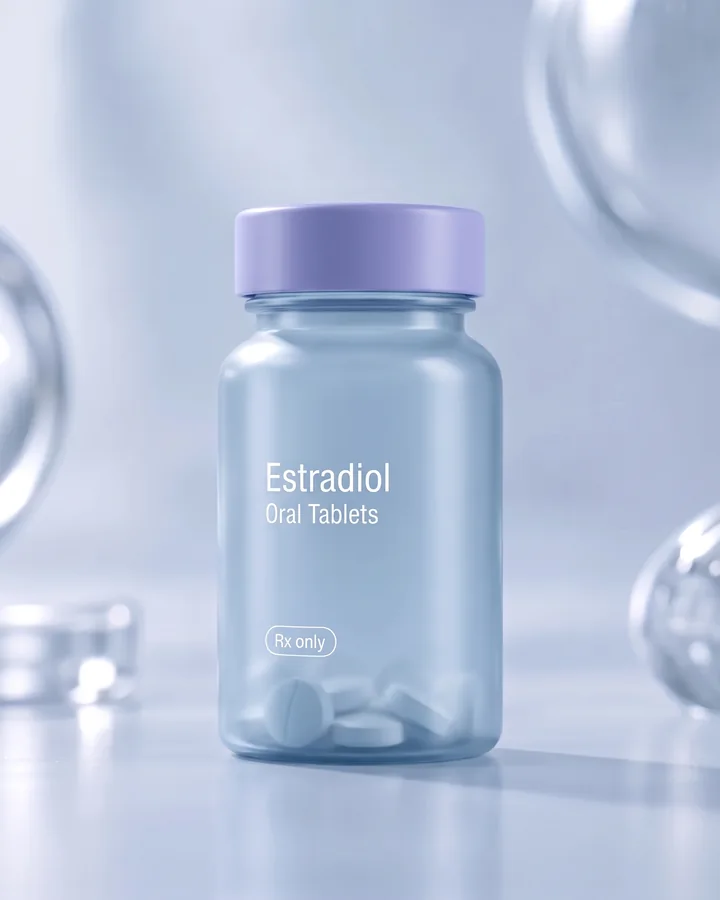
Women's HealthFDA-approved · Patch, gel or tablet · Rx only
Estradiol (Menopause Hormone Therapy)
Provider-guided care for menopause symptoms
Estradiol is an FDA-approved estrogen that comes as a skin patch, a skin gel and an oral tablet. It is used to treat moderate to severe hot flashes and other symptoms of menopause, and it is prescribed online only if a licensed provider decides it is right for you after reviewing your health history.
Estradiol is an FDA-approved estrogen available as a patch, gel or tablet; if a licensed provider prescribes it, it may help with:
Hot flashes
Approved to treat moderate to severe hot flashes due to menopause.
Vaginal dryness
Some products are also approved for moderate to severe vaginal dryness and irritation after menopause.
Replaces what declines
Works by replacing some of the estrogen the ovaries make much less of around menopause.
Patch, gel or tablet
Your provider decides which form and dose fit you after reviewing your health history.
Follow-up in your portal
Message your care team and manage follow-up through the patient portal.
Not medical advice. Individual results vary. A licensed provider decides whether a treatment is right for you.
Understanding Estradiol
What to know first.
Approved use
Estradiol patches, gels and tablets are FDA-approved to treat moderate to severe vasomotor symptoms (hot flashes) due to menopause. Depending on the product, the label may also cover: treatment of moderate to severe symptoms of vulvar and vaginal atrophy due to menopause (when prescribing only for these symptoms, the labels say topical vaginal products should be considered first); treatment of low estrogen (hypoestrogenism) due to hypogonadism, castration or primary ovarian failure; and prevention of postmenopausal osteoporosis, limited to women at significant risk for whom non-estrogen medicines are not considered appropriate. Estradiol tablets are additionally approved, for palliation only, in certain metastatic breast cancers and in advanced androgen-dependent prostate cancer. Some estradiol gels are approved for vasomotor symptoms only. This page discusses estradiol for menopause symptoms; the approved uses of the exact product you are prescribed are listed on its label.
How it works
Estradiol is a form of estrogen, the hormone the ovaries make much less of around menopause. Replacing some of it may ease hot flashes and vaginal dryness, itching or burning for some people; how much it helps varies. The patch releases estradiol through the skin while it is worn, the gel is absorbed through the skin after it dries, and the tablet is taken by mouth. If treatment is appropriate, your provider decides which form and dose fit you.
Who it may be for
A provider may consider estradiol for adults with moderate to severe menopause symptoms after reviewing personal and family history. It is not for people with unexplained vaginal bleeding, current or past breast cancer or another estrogen-dependent cancer, current or past blood clots, a stroke or heart attack, liver disease, a known clotting disorder, or a known or suspected pregnancy. If you have a uterus, the labels say a progestogen should also be prescribed to reduce the risk of endometrial (uterine) cancer. Your provider decides.
How it works
Three steps, all online.
01
Complete your online visit
Answer questions about your health history, medications and goals. Submitting a visit does not guarantee a prescription.
02
A licensed provider reviews
A provider licensed in your state decides whether treatment is appropriate for you, or recommends a different path.
03
If prescribed, delivered
A licensed pharmacy dispenses your medication and ships it to your door. Follow-up continues through the patient portal.
Hormone therapy replaces some of the estrogen the body makes less of around menopause. Estradiol is FDA-approved to treat moderate to severe hot flashes and, depending on the product, moderate to severe vaginal symptoms of menopause. It comes as a patch worn on the skin, a gel applied to the skin and a tablet taken by mouth; vaginal creams, inserts and rings are separate products. A licensed provider reviews your symptoms, history and goals to decide whether any option is appropriate for you and, if so, which form fits.
Patch, gel or tablet: what is the difference?
All three deliver the same hormone. The patch is applied to clean, dry skin of the lower abdomen or buttock, never on or near the breasts, and sites are rotated; the gel is spread on the upper thigh, contains alcohol and is flammable until dry, so you let it dry before dressing, wash your hands and avoid skin contact with others until then; the tablet is swallowed. The labels do not rank one form above another. Your provider chooses with you based on your history and preferences and sets the dose.
Why might a provider add a progestogen?
Estrogen taken alone raises the risk of endometrial cancer, the cancer of the lining of the uterus. The estradiol labels say that when estrogen is prescribed for a postmenopausal woman with a uterus, a progestogen should also be prescribed to reduce that risk, and that a woman without a uterus does not need one. Adding a progestogen may carry its own risks, including a possible increase in breast cancer risk. Your provider explains what applies to you.
What does the boxed warning mean?
A boxed warning is the FDA's most prominent safety warning. On current estradiol labels it covers the higher risk of endometrial cancer with estrogen alone, and the stroke, blood clot, heart attack, breast cancer and probable dementia findings of the Women's Health Initiative studies. It also says estrogen should not be used to prevent heart disease or dementia. Your provider weighs these risks against your symptoms and history before prescribing anything.
I heard the FDA changed hormone therapy warnings. What changed?
In November 2025 the FDA asked makers of menopausal hormone therapy to remove the cardiovascular disease, breast cancer and probable dementia language, and the advice to use the lowest dose for the shortest time, from boxed warnings, keeping an endometrial cancer boxed warning for systemic estrogen-alone products. Cardiovascular and breast cancer risks still appear elsewhere in the labeling. The first updated labels were approved in February 2026 and others are following product by product; the safety information on this page follows the current labels of the generic estradiol tablet, patch and gel.
Do I still need in-person check-ups?
Yes. The estradiol labels advise a yearly check-up with breast exams and mammograms unless your health care professional tells you otherwise, and prompt evaluation of any unusual vaginal bleeding. Forever Health Rx does not offer in-person visits, so this care happens with your own local health care professionals. Your provider can explain what is recommended for you.
How does the online visit work?
You complete a health assessment online and a licensed provider reviews your answers and history. If they decide estradiol is appropriate, a licensed pharmacy dispenses the form they prescribe. Forever Health Rx is a telemedicine platform, not a pharmacy, and completing an assessment or paying does not mean you will receive a prescription. Not everyone qualifies, and individual results vary.
Important Safety Information — Estradiol (Menopause Hormone Therapy)
Warning: Endometrial cancer, cardiovascular disorders, probable dementia and breast cancer
Estrogen taken alone increases the risk of endometrial (uterine) cancer in a woman with a uterus. Adding a progestogen has been shown to reduce the risk of endometrial hyperplasia, which may lead to that cancer. Any undiagnosed, persistent or recurring abnormal vaginal bleeding should be evaluated, including endometrial sampling when indicated, to rule out cancer. Estrogen, with or without a progestogen, should not be used to prevent heart disease or dementia. The Women's Health Initiative (WHI) estrogen-alone study reported increased risks of stroke and deep vein thrombosis in postmenopausal women aged 50 to 79 taking oral conjugated estrogens alone, and the estrogen-plus-progestin study reported increased risks of heart attack, stroke, invasive breast cancer, blood clots in the lungs and deep vein thrombosis with oral conjugated estrogens plus medroxyprogesterone acetate. The WHI Memory Study reported an increased risk of probable dementia in postmenopausal women 65 or older on either regimen; it is unknown whether this applies to younger women. The WHI studied only one oral estrogen product, and the labels say that in the absence of comparable data other estrogen products, including patches and gels, should be assumed to carry similar risks. The current labels advise prescribing estrogen at the lowest effective dose and for the shortest duration consistent with treatment goals and risks for each woman.
What is it approved for?
Estradiol patches, gels and tablets are FDA-approved to treat moderate to severe vasomotor symptoms (hot flashes) due to menopause. Depending on the product, the label may also cover: treatment of moderate to severe symptoms of vulvar and vaginal atrophy due to menopause (when prescribing only for these symptoms, the labels say topical vaginal products should be considered first); treatment of low estrogen (hypoestrogenism) due to hypogonadism, castration or primary ovarian failure; and prevention of postmenopausal osteoporosis, limited to women at significant risk for whom non-estrogen medicines are not considered appropriate. Estradiol tablets are additionally approved, for palliation only, in certain metastatic breast cancers and in advanced androgen-dependent prostate cancer. Some estradiol gels are approved for vasomotor symptoms only. This page discusses estradiol for menopause symptoms; the approved uses of the exact product you are prescribed are listed on its label.
Do not use if
Unusual or abnormal vaginal bleeding that has not been evaluated
Current or past breast cancer, or a known or suspected estrogen-dependent cancer
Current or past blood clots in the legs or lungs (deep vein thrombosis or pulmonary embolism)
A stroke, heart attack or other arterial clotting event, now or in the past
A known clotting disorder such as protein C, protein S or antithrombin deficiency
Liver problems or liver disease
A past anaphylactic reaction, angioedema or other allergy to estradiol or any ingredient of the product
Known or suspected pregnancy
Before starting, tell your provider if
Whether you still have your uterus (have not had a hysterectomy)
Asthma, epilepsy (seizures), migraine, endometriosis, lupus, porphyria, diabetes, hereditary angioedema, high or low calcium levels, liver hemangiomas, or problems with your heart, liver, thyroid or kidneys
High blood pressure, high triglycerides, high cholesterol, tobacco use, or a past episode of cholestatic jaundice (yellowing of the skin or eyes)
Thyroid hormone use, because estrogen can change how much thyroid medicine you need
All medicines and supplements, including St. John's wort, phenobarbital, carbamazepine, rifampin, erythromycin, clarithromycin, ketoconazole, itraconazole, ritonavir and grapefruit juice, which can change estrogen levels
Planned surgery or a period of bed rest, since estrogen may need to be stopped beforehand
If you use the gel: sunscreen or lotion on the application area, which the label says has not been studied with this gel and may change absorption
Breastfeeding
Serious side effects — get medical help right away
Stroke, heart attack and blood clots. Get emergency help for chest pain, pain in your calves, sudden shortness of breath or coughing up blood, a severe headache or vomiting, dizziness or faintness, changes in vision or speech, or weakness or numbness of an arm or leg.
Cancer of the uterus (endometrial cancer). Report any unusual vaginal bleeding right away. After menopause, vaginal bleeding may be a warning sign of uterine cancer.
Breast cancer. Tell your provider about any breast lump. The labels advise a breast exam and mammogram every year unless your health care professional advises otherwise.
Ovarian cancer. Studies have reported an increased risk of ovarian cancer in women who used hormone therapy for menopause symptoms.
Dementia. In a study of women 65 and older, hormone therapy was linked with a higher risk of probable dementia.
Gallbladder disease and liver problems. Tell your provider about pain, swelling or tenderness in the abdomen, or yellowing of the skin or eyes.
Vision problems. Blood clots in the retina have been reported with estrogen. Stop and get prompt care for sudden partial or complete loss of vision, sudden bulging of the eyes, double vision or migraine.
High blood pressure, fluid retention and high triglycerides. The labels list raised blood pressure, fluid retention and worsening of high triglycerides, which can lead to pancreatitis, among the warnings. Keep your usual check-ups and report swelling or severe abdominal pain.
Common side effects
Common side effects: headache, breast pain or tenderness, irregular vaginal bleeding or spotting, stomach cramps, bloating or abdominal pain, nausea and vomiting, hair loss, fluid retention (swelling), vaginal yeast infection, cold-like symptoms and upper respiratory infections, and, with the patch or gel, skin irritation where it is applied. These are not all the possible side effects.
You may report side effects to the FDA at 1-800-FDA-1088 or www.fda.gov/medwatch.
Pregnancy and breastfeeding
Estradiol should not be used during pregnancy; there is no indication for it in pregnancy. Estrogen passes into breast milk and has been shown to reduce the amount and quality of milk, so tell your provider if you are breastfeeding.
Estradiol gel contains alcohol and is flammable: avoid fire, flames and smoking until it has dried. Let it dry before dressing, wash your hands with soap and water after applying, do not wash the area for at least an hour, and keep children and pets away from the application site; if someone touches wet gel, have them wash the area promptly.
Apply the patch to clean, dry skin of the lower abdomen or upper buttock, never on or near the breasts or on irritated skin, and rotate sites. Fold a used patch sticky side in and place it in a child-proof container in the trash; do not flush it.
Prescription only. Estradiol is available only after an online visit with a licensed provider, who determines whether treatment is appropriate for you. This summary does not replace the full prescribing information. Not medical advice. Results may vary.
Forever Health Rx does not provide emergency medical care. Call 911 or go to the nearest emergency department if you are experiencing a medical emergency. For urgent questions about a serious side effect, message your care team through the patient portal and seek in-person care if symptoms are severe.
Your next step
Start with a free online visit.
About ten minutes. A licensed provider reviews your information and decides whether treatment is right for you.
Have a question before you start? Call our support team:
Prescription required. Eligibility is determined by a licensed provider. Not medical advice. Results may vary.
Important safety & regulatory information
Please read before you start.
Forever Health Rx is a healthcare technology platform operated by . Forever Health Rx is not a pharmacy and does not practice medicine. Medical services are provided by independent, state-licensed healthcare providers of , who exercise their own clinical judgment. Prescriptions are issued only after a provider reviews your information and determines that treatment is appropriate for you. Not everyone qualifies, and no treatment, outcome or eligibility is guaranteed.
Some medications referenced on this site are compounded preparations prepared by U.S. pharmacies licensed in the state where they dispense. Compounded drugs are not approved by the FDA and are not evaluated by the FDA for safety, effectiveness or quality. They are not generic versions of, or equivalent to, any branded medication. Other medications referenced are FDA-approved products, described only for their FDA-approved uses unless a page states that a use is off-label. Brand names are trademarks of their respective owners; Forever Health Rx is not affiliated with them.
Every prescription medication carries risks. Product-specific warnings, contraindications and side effects are listed in the safety information on each treatment page; discuss your full medical history and every medication you take with your provider. Treatments shown as coming soon are not yet available for purchase, and their prices may be estimates.
This website does not provide medical advice and is not a substitute for consultation with a qualified clinician. In an emergency, call 911. To report a side effect, contact your provider through the patient portal or the FDA MedWatch program at 1-800-FDA-1088.
Weight figures, timelines and projections shown anywhere on this site are illustrative and drawn from published clinical literature, not from Forever Health Rx patient outcomes. Individual results vary.
Your provider confirms the plan and its cost after review. Payment collected at checkout is refunded in full if a prescription is not issued, and nothing is dispensed. The final amount is always shown at checkout before you authorize payment.
This website collects no protected health information; your online visit, prescriptions and messages take place inside the secure patient portal, covered by our HIPAA Privacy Policy.
People pictured on this site are illustrative images, not Forever Health Rx patients. They do not describe anyone's treatment experience and do not depict the results of any medication. Product images are illustrative; actual packaging may vary.